
The clause
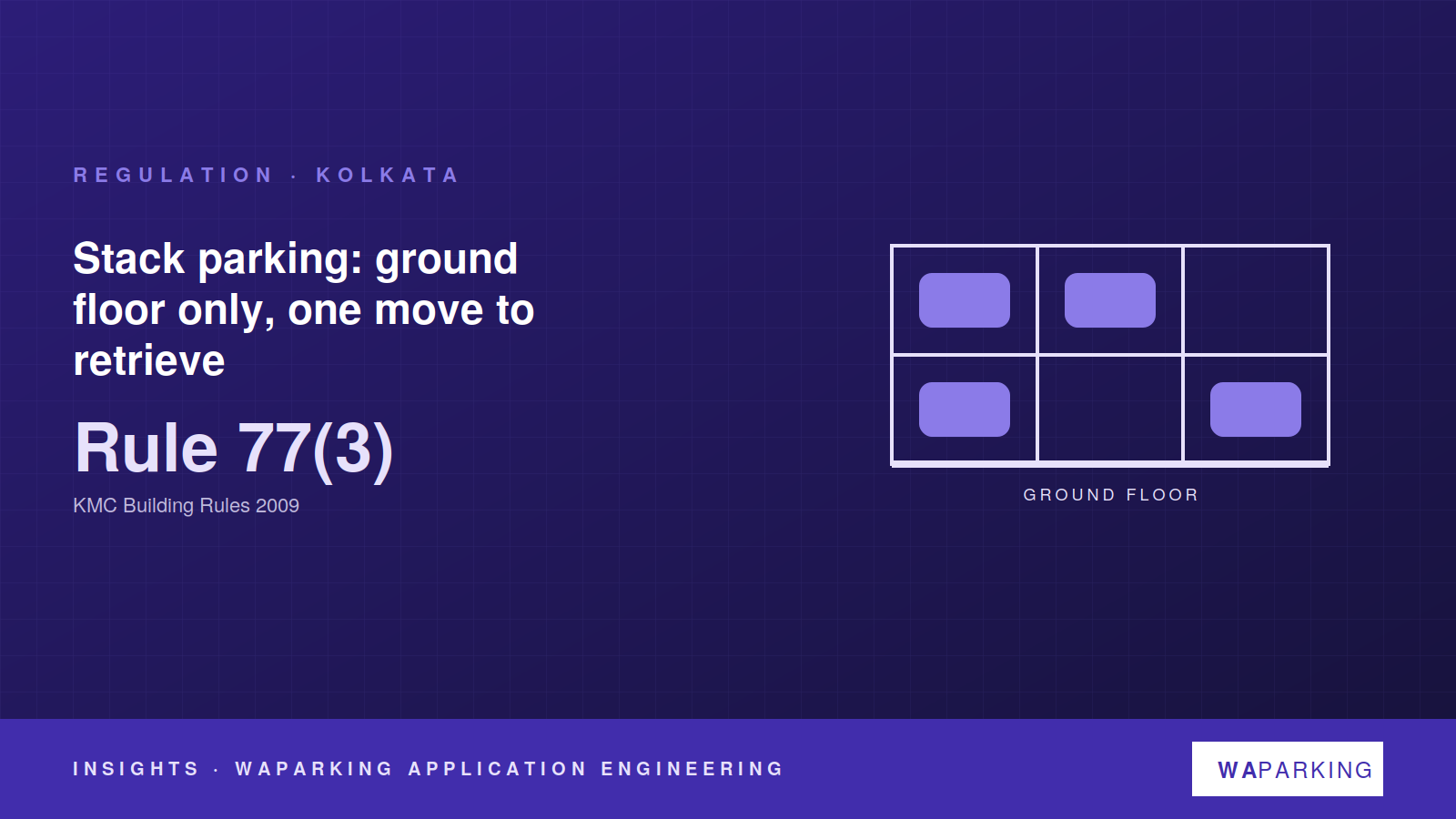
Kolkata Municipal Corporation's Building Rules 2009, Rule 77(3): stack car parking is permitted only where each car can be moved out by shifting not more than one other car, and only at ground-floor level. Each space must be directly accessible from a driveway or aisle.
Read plainly, that allows a two-level dependent stacker on the ground floor and nothing else — no stackers in the basement or on podium floors, no puzzle systems where a car may need two moves, and no automated towers without a specific approval that the rule itself does not provide.
Why the rule exists
Kolkata's building stock is dense, its streets narrow (Rule 77(5) even waives parking where the abutting street is under 3.5 m), and its fire service has historically had limited reach above ground. The one-move condition is a retrieval-time rule dressed as a parking rule: a car must be reachable quickly, at grade, without a system in between.
What it does to a scheme
| System | Permitted under 77(3)? | Route |
|---|---|---|
| Two-level dependent stack, ground floor | Yes | Standard sanction |
| Two-level stack, basement or podium | No | Not under the rule |
| Puzzle (any level) | No — may need two moves | Specific approval sought as a relaxation |
| Automated tower | No | Specific approval; treated case by case |
The FAR exemption still helps: covered parking is free of FAR up to 25 sqm per car on the ground floor and 40 sqm on upper floors (Rule 69(g)), and the April 2025 draft amendment keeps those figures and adds 50 sqm per bus or truck. So a ground-floor stacker inside a 25 sqm envelope is both permitted and FAR-neutral.
Designing to it
- Put every stacker on the ground floor, and keep the 4.0 m circulation driveway (Rule 77(2)) clear.
- Use dependent two-level systems; independent-access stackers are permitted but rarely justify their pit.
- Where a puzzle or tower is the only way a plot works, document the retrieval logic — how each car reaches the aisle — and apply for a relaxation before design, not after.
- Watch the 2025 amendment: it is a preliminary notification and may move the rule.