
The bands
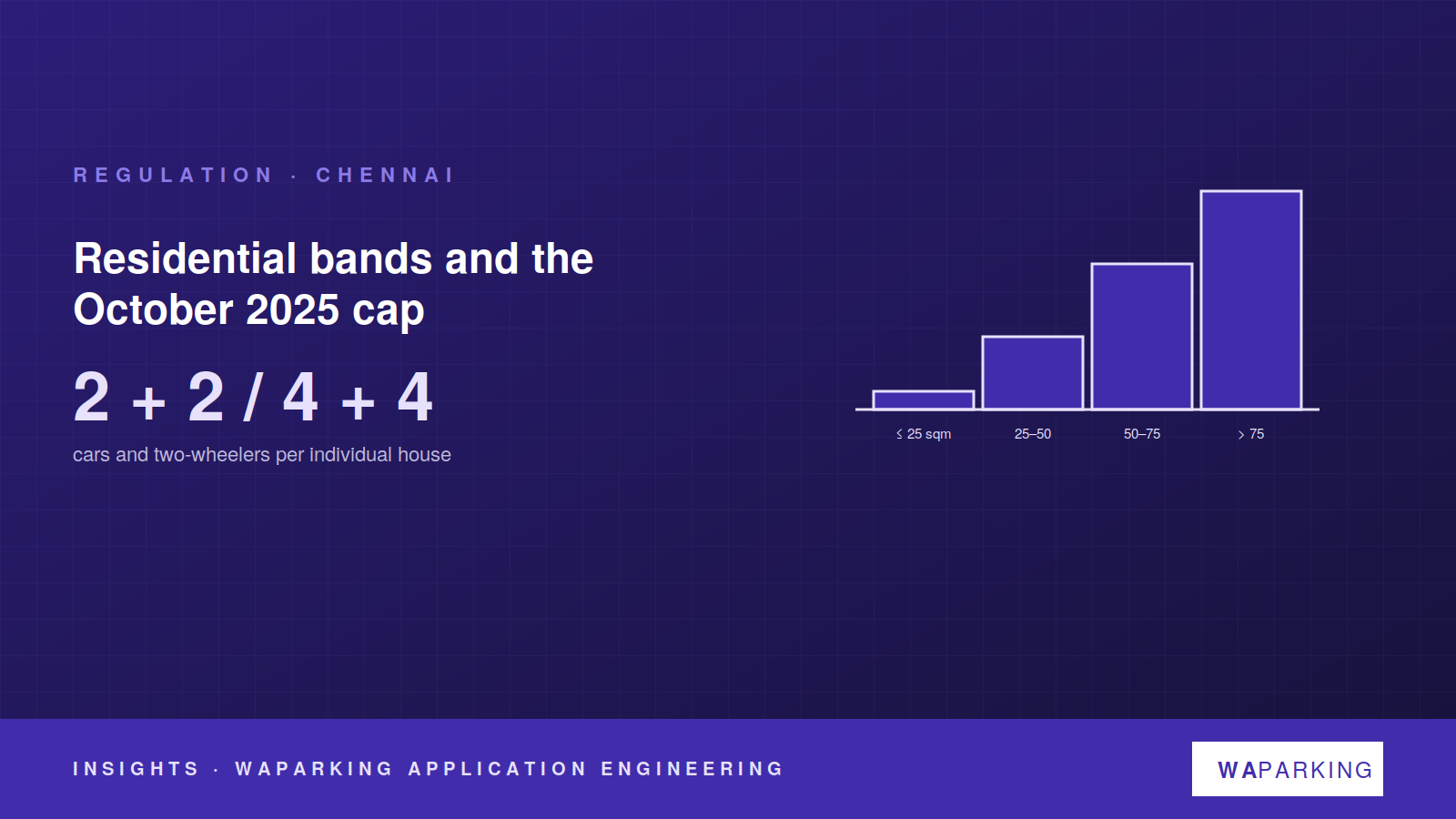
Annexure IV of the Tamil Nadu Combined Development and Building Rules 2019 sets residential parking by the floor area of each dwelling unit, with one column for the Chennai Metropolitan Area and another for the rest of the state. In Chennai:
| Dwelling floor area | Cars | Two-wheelers |
|---|---|---|
| Up to 25 sqm | Nil | Nil |
| 25 to 50 sqm | Nil | 1 per unit |
| 50 to 75 sqm | 1 per 2 units | 1 per unit |
| Above 75 sqm | 1 per unit | 1 per unit |
Outside the CMA the bands shift up by one step — nothing to 50 sqm, a car only from 100 sqm.
What changed in October 2025
A Government Order of 10 October 2025 substituted item 5 of the residential notes. An individual house with a single dwelling unit up to 300 sqm may provide at most two car and two two-wheeler spaces; above 300 sqm, four and four. The rule is a ceiling, not a floor: it stops plot owners converting ground floors into parking for sale or rent, which had become a way of adding a commercial use to a residential plot.
For apartment developers the amendment changes nothing. For plotted developments and villa schemes it sets the number of stackers a house may hold.
Where mechanical parking sits
TNCDBR recognises "multi-storeyed parking lots" as a building type and requires a minimum 12 m road for them (Rule 35). Within a sanctioned parking layout, stack and puzzle systems are accepted as spaces provided each remains accessible; the driveway must be 3.0 m one-way and 6.0 m two-way. There is no express area-per-car rule to negotiate, which makes Chennai simpler than Hyderabad or Bengaluru for a mechanical scheme — the count is the count.
Two things to confirm before a submission
- Which column applies: the CMA boundary decides whether a 60 sqm flat attracts half a car or none.
- Commercial rows in Annexure IV Part II — the 75 sqm and 50 sqm per car figures quoted by consultants differ between panchayat and CMA areas and should be read from the table.