
Three families, three geometries
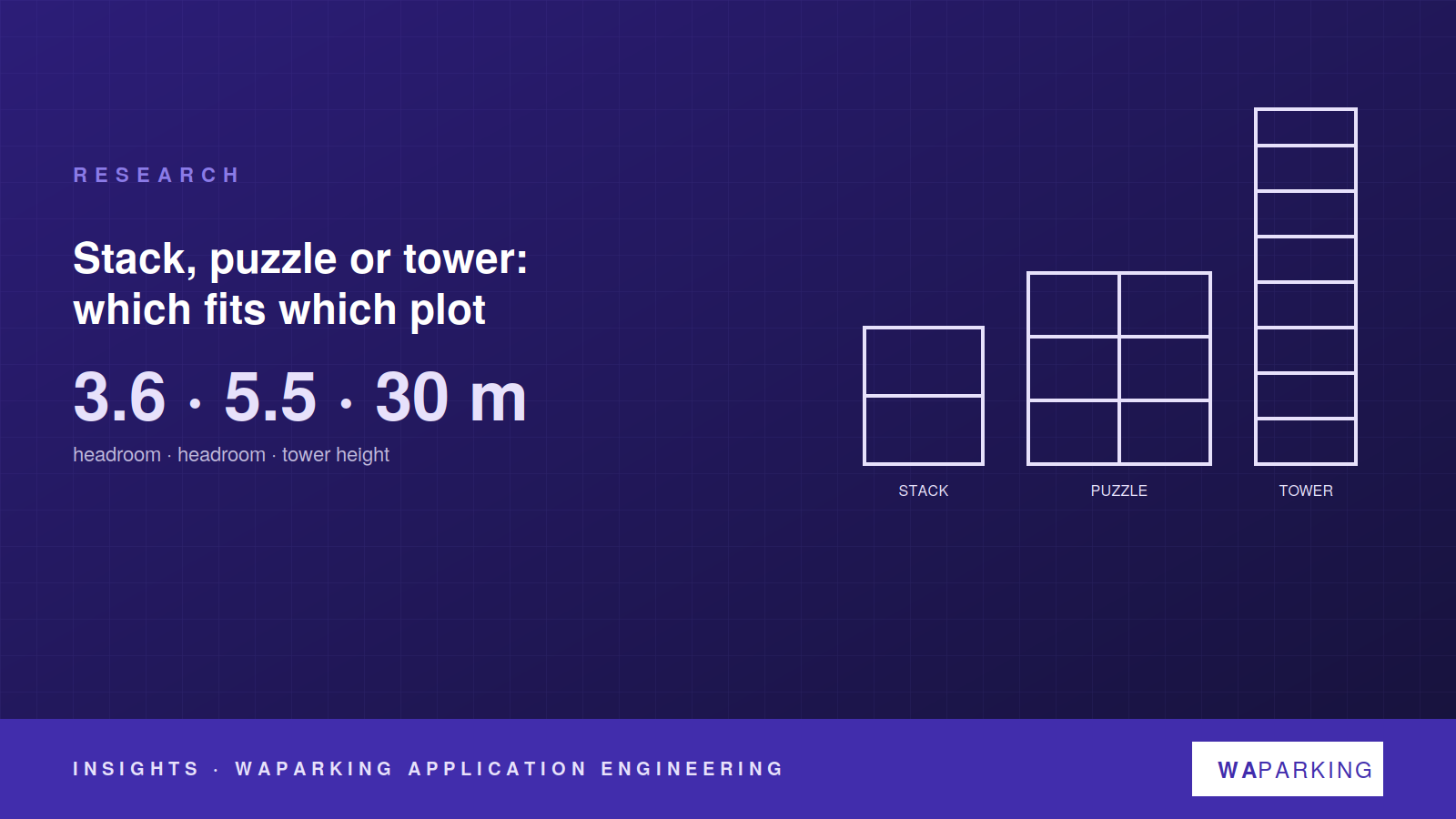
Dependent stackers lift one car above another. Two levels need about 3.6 m of clear height, three levels about 5.4 m. The lower car must move out to release the upper one, so they suit allocated parking — one owner, two cars — and sit happily in stilts and basements.
Puzzle systems combine lifting with sideways shifting so every car is independently retrievable. A two-level puzzle needs around 3.6 to 3.8 m; each further level adds roughly 1.8 m. They need one empty ground position per row, a level slab and, under the 2024 Maharashtra fire circular, sprinklers over every car and rated decks. They suit visitor and unallocated parking, rear margins and podiums.
Automated towers and shuttle systems park cars by machine in a steel or concrete structure. Footprint is small — a 40 to 60 car tower stands on under 100 sqm — and capacity scales with height. They need a fire package (two-hour separation, sprinklers, detection), a retrieval-time budget of 90 to 150 seconds per car, and a maintenance contract that outlives the sale.
The decision in three numbers
| Plot condition | Stack | Puzzle | Tower |
|---|---|---|---|
| Headroom ≥ 3.6 m, allocated bays | Best fit | Works | Overkill |
| Headroom ≥ 5.5 m, unallocated bays | Limited | Best fit | Works |
| Footprint under 300 sqm, 40+ cars | No | Limited | Best fit |
| Commercial with peak arrival / departure | Works | Works | Retrieval time governs |
| Kolkata (ground floor, one-move rule) | Ground floor only | Relaxation needed | Relaxation needed |
Where each fails
Stackers fail on management: the moment two owners share a column, someone is blocked. Puzzles fail on the slab — a 30 mm level tolerance over the system length is the usual site problem — and on the empty position everyone tries to fill. Towers fail on maintenance culture: a system that is 98% available still leaves a car stuck two days a year, and the society must fund the AMC.
What to ask before choosing
- What is the clear height under the beam, not under the slab?
- Will bays be allocated to flats or pooled?
- What is the peak departure rate — how many cars leave between 8 and 9 in the morning?
- Who pays for maintenance after occupation certificate?
- Which regulation governs: is the plot in a city that limits levels, heights or where systems may stand?